

|
v2.0.0
|
Loading...
Searching...
No Matches
|
|
v2.0.0
|
Centralised BIDS vocabulary: datatype / suffix / extension whitelists, FIFF↔BIDS channel-type and coordinate-frame maps, and entity ordering. More...
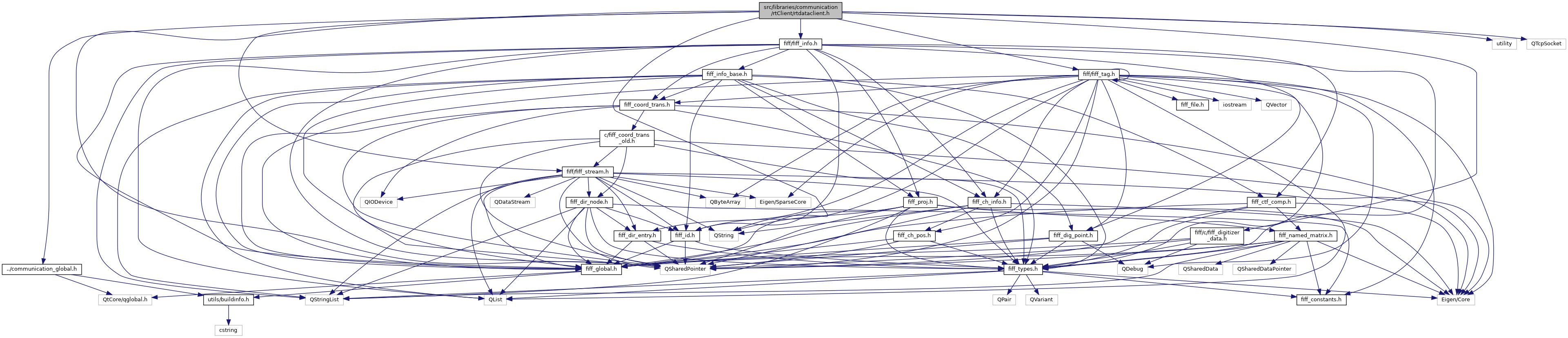
Go to the source code of this file.
Namespaces | |
| namespace | BIDSLIB |
| BIDS dataset reading, writing, path construction, and sidecar metadata handling for iEEG/EEG/MEG. | |
Functions | |
| QStringList | BIDSLIB::allowedElectrophysiologyDatatypes () |
| QStringList | BIDSLIB::allowedDatatypes () |
| QStringList | BIDSLIB::ieegAllowedExtensions () |
| QStringList | BIDSLIB::eegAllowedExtensions () |
| QMap< int, QString > | BIDSLIB::fiffKindToBidsType () |
| QMap< QString, int > | BIDSLIB::bidsTypeToFiffKind () |
| QMap< QString, int > | BIDSLIB::bidsCoordToFiffFrame () |
| QMap< int, QString > | BIDSLIB::fiffFrameToBidsCoord () |
| QStringList | BIDSLIB::ieegAllowedCoordSystems () |
| QStringList | BIDSLIB::bidsEntityOrder () |
Variables | |
| const QString | BIDSLIB::BIDS_DATATYPE_MEG = QStringLiteral("meg") |
| const QString | BIDSLIB::BIDS_DATATYPE_EEG = QStringLiteral("eeg") |
| const QString | BIDSLIB::BIDS_DATATYPE_IEEG = QStringLiteral("ieeg") |
| const QString | BIDSLIB::BIDS_DATATYPE_ANAT = QStringLiteral("anat") |
| const QString | BIDSLIB::BIDS_DATATYPE_FUNC = QStringLiteral("func") |
| const QString | BIDSLIB::BIDS_DATATYPE_DWI = QStringLiteral("dwi") |
| const QString | BIDSLIB::BIDS_DATATYPE_PERF = QStringLiteral("perf") |
| const QString | BIDSLIB::BIDS_DATATYPE_BEH = QStringLiteral("beh") |
Centralised BIDS vocabulary: datatype / suffix / extension whitelists, FIFF↔BIDS channel-type and coordinate-frame maps, and entity ordering.
SPDX-License-Identifier: BSD-3-Clause Copyright (c) 2026 MNE-CPP Authors
Every other translation unit in BIDSLIB derives its allowed values from the constants defined here, so a future BIDS specification bump (currently 1.9.x) only requires touching this header. The file groups five orthogonal concerns: BIDS datatype strings (meg, eeg, ieeg, anat, …), per-modality raw-data file extension whitelists, bidirectional FIFF-kind ↔ BIDS channel-type maps used by BIDSLIB::BidsChannel and BIDSLIB::BidsRawData, coordinate-system name ↔ FIFFV_COORD_* maps used by BIDSLIB::BidsCoordinateSystem, and the canonical entity order (sub, ses, task, acq, run, …) consumed by BIDSLIB::BIDSPath when it serialises a filename.
Header-only and inline so the maps are constant-folded at the call sites and to avoid a hidden ODR surface for translation units that only need one or two entries.
Definition in file bids_const.h.
 1.16.1