

|
v2.0.0
|
Loading...
Searching...
No Matches
|
|
v2.0.0
|
Gamma-MAP sparse Bayesian inverse solver — automatic-relevance-determination prior on per-source variance hyperparameters. More...
#include "../inv_global.h"#include "../inv_source_estimate.h"#include <Eigen/Core>#include <Eigen/Dense>#include <QVector>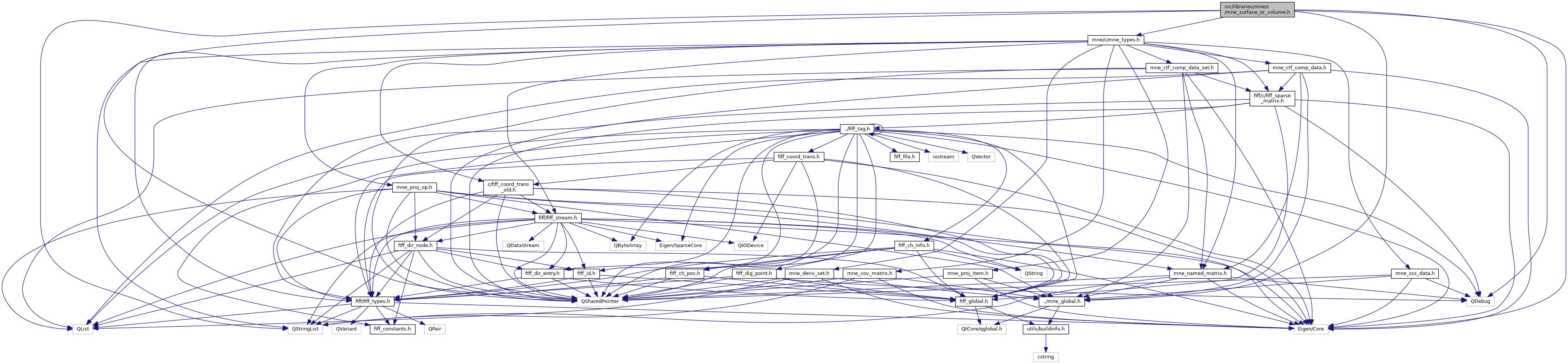

Go to the source code of this file.
Classes | |
| struct | INVLIB::InvGammaMapResult |
| class | INVLIB::InvGammaMap |
| Gamma-MAP sparse inverse solver. More... | |
Namespaces | |
| namespace | INVLIB |
| Inverse source estimation (MNE, dSPM, sLORETA, dipole fitting). | |
Gamma-MAP sparse Bayesian inverse solver — automatic-relevance-determination prior on per-source variance hyperparameters.
SPDX-License-Identifier: BSD-3-Clause Copyright (c) 2026 MNE-CPP Authors
INVLIB::InvGammaMap implements the Gamma-MAP / sparse Bayesian learning (SBL) solver of Wipf & Rao, NeuroImage 44(3), 947-966 (2009). The algorithm models source amplitudes as Gaussians with per-source variance hyperparameters \(\gamma_{i}\) and uses an MacKay fixed-point update (as in mne.inverse_sparse.gamma_map) to re-estimate the \(\gamma\) vector from the data; sources whose \(\gamma_{i}\) collapses below threshold are pruned, leaving a sparse active set. Output is an INVLIB::InvGammaMapResult carrying the INVLIB::InvSourceEstimate, the surviving active-vertex list, the final \(\gamma\) vector, iteration count and residual norm.
Definition in file inv_gamma_map.h.
 1.16.1