

|
v2.0.0
|
Loading...
Searching...
No Matches
|
|
v2.0.0
|
Implementation of the cluster permutation tests and TFCE enhancement declared in sts_cluster.h. More...
#include "sts_cluster.h"#include "sts_ttest.h"#include "sts_ftest.h"#include <QtConcurrent>#include <QRandomGenerator>#include <cmath>#include <algorithm>#include <queue>#include <vector>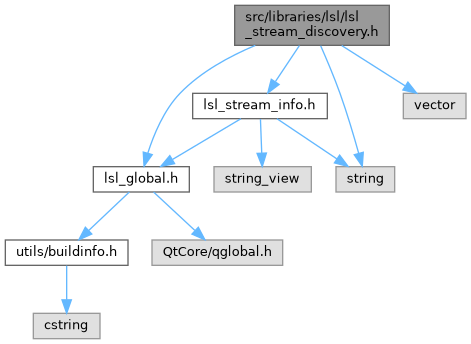
Go to the source code of this file.
Implementation of the cluster permutation tests and TFCE enhancement declared in sts_cluster.h.
SPDX-License-Identifier: BSD-3-Clause Copyright (c) 2026 MNE-CPP Authors
Each permutation entry point first computes the observed statistic map (paired or one-sample t for the t-variants, one-way ANOVA F for the fTestPermutationTest) and derives the cluster-forming threshold from clusterAlpha through the inverse Student-t CDF. Connected supra-threshold components are extracted with a queue-based breadth-first search over the STSLIB::StatsAdjacency sparse graph and each component is assigned a cluster-mass equal to the sum of its t- or F-values.
The null distribution of the maximum absolute cluster-mass is then built by QtConcurrent::blockingMapped over nPermutations randomisations - exchangeable label shuffles for the two-sample test, Rademacher sign flips for the one-sample test, and group-label reassignments for the ANOVA test - with thread-local QRandomGenerator instances for reproducibility. Observed cluster p-values count the observed statistic as one draw from that null, as MNE-Python does: p = (1 + #exceedances) / (1 + nPermutations).
TFCE follows Smith & Nichols (2009): the statistic map is swept by nSteps thresholds below the largest absolute statistic, as MNE-Python does, and each supra-threshold connected component contributes \(\text{extent}^E \cdot h^H \cdot \Delta h\) to every sample it covers. Positive and negative tails are handled separately and recombined so signed enhancement is preserved.
Definition in file sts_cluster.cpp.
 1.16.1