Read an evoked response
Read an evoked data set from FIFF and print its measurement info and coordinate transforms.
Libraries: Visualization, MNE Core, FIFF I/O, Utilities
Results
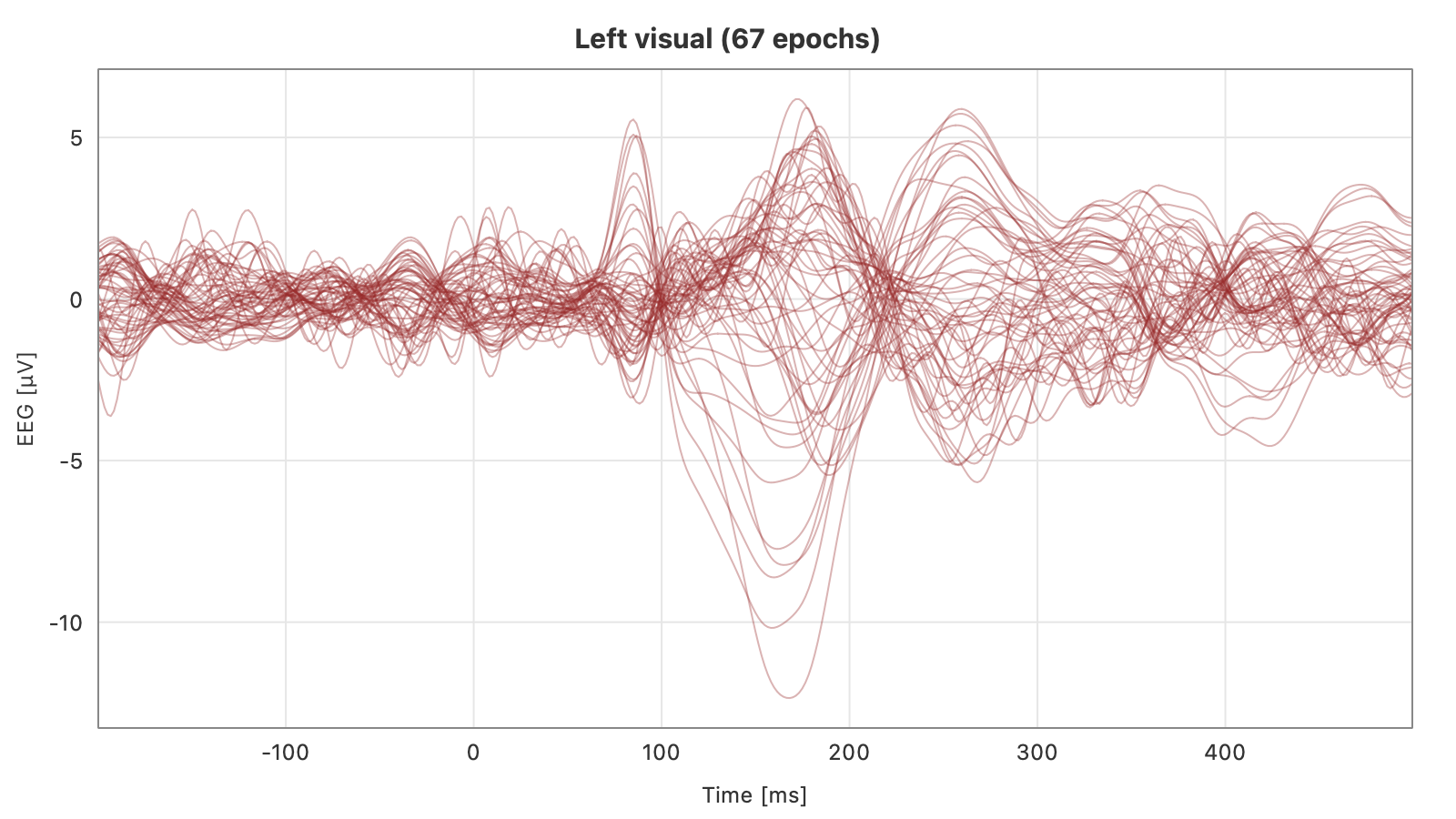
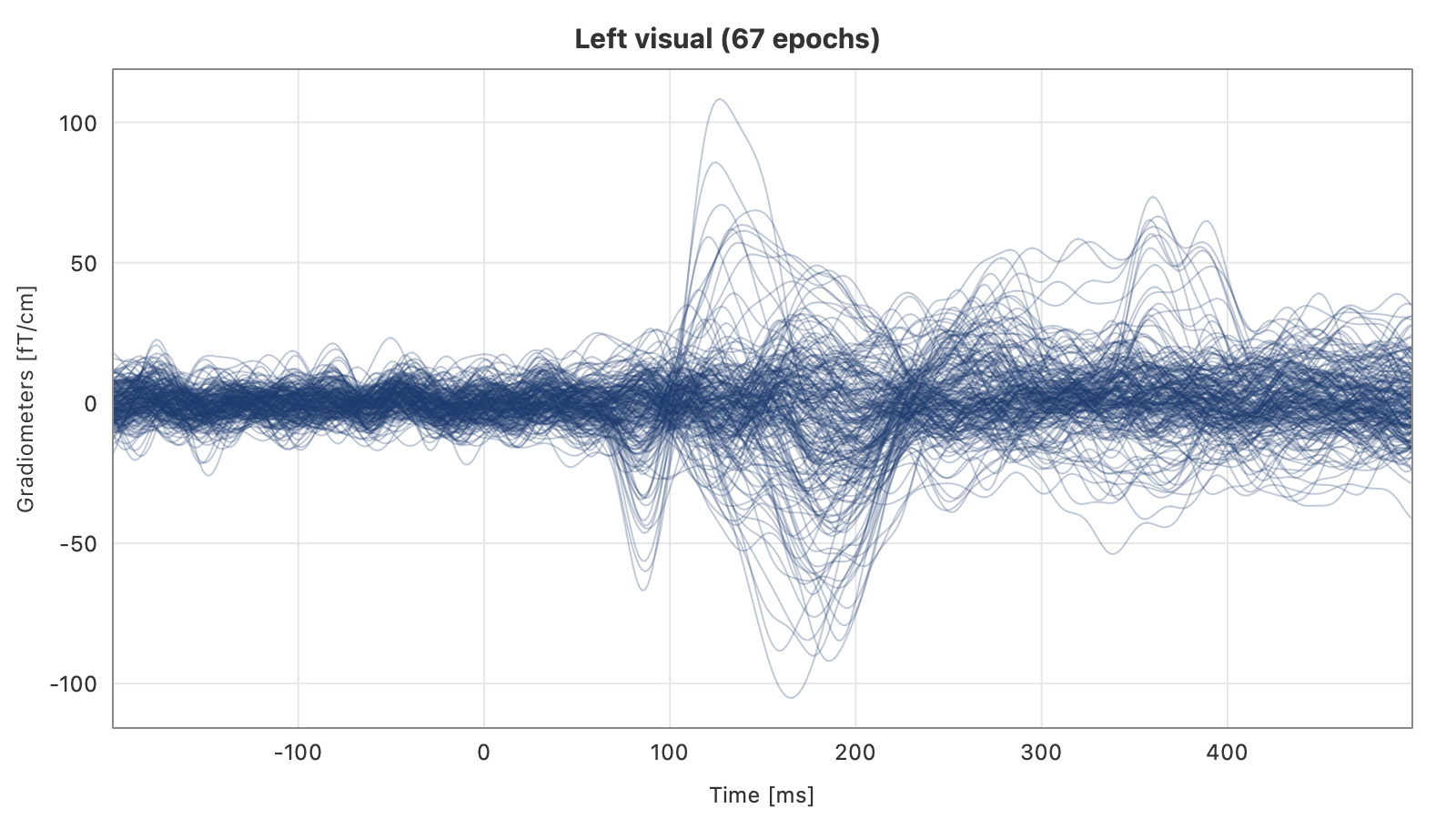
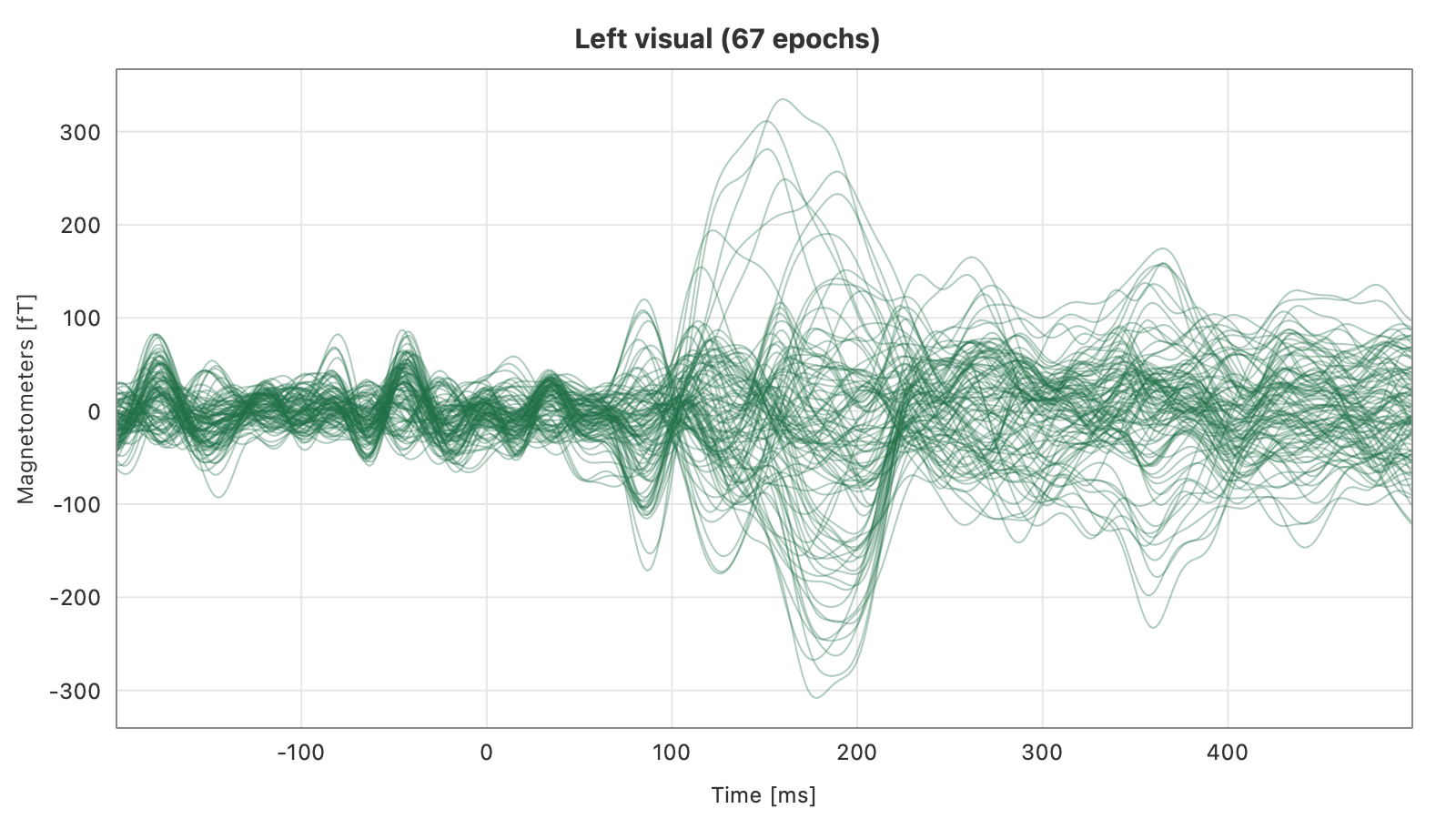
Console output
Reading resources/data/MNE-sample-data/MEG/sample/sample_audvis-ave.fif ...
Creating tag directory for resources/data/MNE-sample-data/MEG/sample/sample_audvis-ave.fif...
	Read a total of 4 projection items:
		PCA-v1 (1 x 10²) active
		PCA-v2 (1 x 10²) active
		PCA-v3 (1 x 10²) active
		Average EEG reference (1 x 60) active
	Found the data of interest:
		t =    -199.80 ...     499.49 ms (Left visual)
		nave = 67 - aspect type = 100

	Preprocessing...
	376 channels remain after picking
	Created an SSP operator (subspace dimension = 4)
	4 projection items activated.
	SSP projectors applied to the evoked data
	No baseline correction applied
Employing the Neuromag head coordinate system

Condition 'Left visual': 67 epochs, 376 channels, 421 samples from -0.199795 s to 0.499488 s
Applying baseline correction ... (mode: mean)
[Numerics::rescale] Applying baseline correction ... (mode: mean)
Line frequency is not defined
QCommandLineParser: option not defined: "useCTFComp"
Background
Build and run
Needs the MNE sample dataset in resources/data/MNE-sample-data.
cmake --build build/developer-dynamic --target ex_read_evoked
./out/Release/examples/ex_read_evoked --help
Options
| Option | Description |
|---|---|
--ave | Path to the evoked/average <file>. |
--aveIdx | The average <index> to choose from the average file. |
--useCTFComp | Use the CTF compensator, if available. |
Key API
The documented classes this example uses most:
| Class | Library |
|---|---|
FiffCoordTrans | FIFF I/O |
FiffEvoked | FIFF I/O |
FigureExporter | Visualization |
LinePlot | Visualization |
MNE | MNE Core |
Used in the API reference
Source
src/examples/ex_read_evoked on GitHub.
src/examples/ex_read_evoked/main.cpp
//=============================================================================================================
/**
 * SPDX-License-Identifier: BSD-3-Clause
 * Copyright (c) 2012-2026 MNE-CPP Authors
 *
 * @file     main.cpp
 * @author   Gabriel Motta <gabrielbenmotta@gmail.com>;
 *           Christoph Dinh <christoph.dinh@mne-cpp.org>;
 *           Lorenz Esch <lorenz.esch@tu-ilmenau.de>
 * @since    0.1.0
 * @date     July, 2012
 * @brief    Read an evoked data set from FIFF and print its measurement info and coordinate transforms.
 */

//=============================================================================================================
// INCLUDES
//=============================================================================================================

#include <iostream>
#include <vector>
#include <math.h>

#include <fiff/fiff.h>
#include <mne/mne.h>
#include <utils/generics/mne_logger.h>

#include <disp/plots/helpers/figureexporter.h>
#include <disp/plots/lineplot.h>

//=============================================================================================================
// QT INCLUDES
//=============================================================================================================

#include <QApplication>
#include <QCommandLineParser>
#include <QFile>

//=============================================================================================================
// USED NAMESPACES
//=============================================================================================================

using namespace DISPLIB;
using namespace FIFFLIB;
using namespace MNELIB;
using namespace UTILSLIB;

//=============================================================================================================
// DEFINE GLOBAL METHODS
//=============================================================================================================

namespace
{

/** Writes a butterfly plot of the channels of @p evoked of @p kind measured in @p unit, scaled by @p scale. */
void saveButterfly(const FiffEvoked& evoked, int kind, int unit, double scale, const QString& name, const QString& yLabel, const QColor& color)
{
    QVector<double> times(evoked.times.size());
    for (int s = 0; s < times.size(); ++s) {
        times[s] = 1000.0 * evoked.times(s);
    }
    LinePlot plot;
    plot.setTitle(QString("%1 (%2 epochs)").arg(evoked.comment).arg(evoked.nave));
    plot.setXLabel("Time [ms]");
    plot.setYLabel(yLabel);
    for (int c = 0; c < evoked.data.rows(); ++c) {
        if (evoked.info.chs[c].kind != kind || evoked.info.chs[c].unit != unit || evoked.info.bads.contains(evoked.info.ch_names[c])) {
            continue;
        }
        QVector<double> values(times.size());
        for (int s = 0; s < times.size(); ++s) {
            values[s] = scale * evoked.data(c, s);
        }
        plot.addSeries(times, values, QString(), color);
    }
    FigureExporter::save(plot, name, QString("%1 of the '%2' response: one line per channel, baseline-corrected, bad channels excluded.").arg(yLabel.section(' ', 0, 0), evoked.comment));
}

} // namespace

//=============================================================================================================
// MAIN
//=============================================================================================================

//=============================================================================================================
/**
 * The function main marks the entry point of the program.
 * By default, main has the storage class extern.
 *
 * @param[in] argc (argument count) is an integer that indicates how many arguments were entered on the command line when the program was started.
 * @param[in] argv (argument vector) is an array of pointers to arrays of character objects. The array objects are null-terminated strings, representing the arguments that were entered on the command line when the program was started.
 * @return the value that was set to exit() (which is 0 if exit() is called via quit()).
 */
int main(int argc, char* argv[])
{
    qInstallMessageHandler(MNELogger::customLogWriter);
    QApplication a(argc, argv);

    // Command Line Parser
    QCommandLineParser parser;
    parser.setApplicationDescription("Read Evoked Example");
    parser.addHelpOption();

    QCommandLineOption evokedFileOption("ave", "Path to the evoked/average <file>.", "file", QCoreApplication::applicationDirPath() + "/../resources/data/MNE-sample-data/MEG/sample/sample_audvis-ave.fif");
    QCommandLineOption evokedIdxOption("aveIdx", "The average <index> to choose from the average file.", "index", "2");
    QCommandLineOption useCTFCompOption("useCTFComp", "Use the CTF compensator, if available.");

    parser.addOption(evokedFileOption);
    parser.addOption(evokedIdxOption);

    parser.process(a);

    //generate FiffEvoked object
    QFile t_sampleFile(parser.value(evokedFileOption));
    FiffEvoked p_FiffEvoked(t_sampleFile, QVariant(parser.value(evokedIdxOption)));

    //Select the head coordinate system
    bool use_ctf_head = parser.isSet(useCTFCompOption);
    FiffCoordTrans meg_trans;

    if (use_ctf_head) {
        if (p_FiffEvoked.info.ctf_head_t.isEmpty())
            std::cout << "\nNo CTF head transformation available" << std::endl;
        else {
            meg_trans = p_FiffEvoked.info.dev_ctf_t;
            FiffCoordTrans eeg_trans(meg_trans);
            eeg_trans.invert_transform();
            std::cout << "Employing the CTF/4D head coordinate system\n"
                      << std::endl;
        }
    } else {
        meg_trans = p_FiffEvoked.info.dev_head_t;
        FiffCoordTrans eeg_trans;
        std::cout << "Employing the Neuromag head coordinate system\n"
                  << std::endl;
    }

    //Transform coil and electrode locations to the desired coordinate frame
    //ToDo: MATLAB root fct fiff_transform_meg_chs and fiff_transform_eeg_chs needs to be implemented

    //Create the coil definitions
    //ToDo: MATLAB root fct mne_add_coil_defs needs to be implemented

    //N.B. If a nonstandard (in MNE sense) coil def file is used, do
    //ToDo: MATLAB root fct mne_load_coil_def, mne_add_coil_defs needs to be implemented

    std::cout << "Condition '" << p_FiffEvoked.comment.toStdString() << "': " << p_FiffEvoked.nave << " epochs, "
              << p_FiffEvoked.info.nchan << " channels, " << p_FiffEvoked.times.size() << " samples from "
              << p_FiffEvoked.times(0) << " s to " << p_FiffEvoked.times(p_FiffEvoked.times.size() - 1) << " s" << std::endl;

    // Plot a copy corrected over the prestimulus interval, as mne.Evoked.plot shows it
    FiffEvoked corrected(p_FiffEvoked);
    QPair<float, float> baseline(p_FiffEvoked.times(0), 0.0f);
    corrected.applyBaselineCorrection(baseline);
    saveButterfly(corrected, FIFFV_EEG_CH, FIFF_UNIT_V, 1e6, "eeg", "EEG [µV]", QColor(150, 40, 40, 90));
    saveButterfly(corrected, FIFFV_MEG_CH, FIFF_UNIT_T_M, 1e13, "gradiometers", "Gradiometers [fT/cm]", QColor(30, 60, 110, 70));
    saveButterfly(corrected, FIFFV_MEG_CH, FIFF_UNIT_T, 1e15, "magnetometers", "Magnetometers [fT]", QColor(30, 110, 70, 90));

    return 0;
}

//=============================================================================================================
// STATIC DEFINITIONS
//=============================================================================================================
Related examples
- Read a segment of raw data — Read a segment of a raw FIFF recording with channel picking, SSP projectors and CTF compensation.
- Tour of the FIFF data structures — FIFF library: measurement info, channels, digitizer, transforms, projectors, covariance, events, annotations, evoked sets and the low-level file structure.
- Epochs, compensation and the FIFF file directory — FIFF library: fixed-length epochs, CTF compensation, the file directory and raw buffers, and handing recordings to another application.
- Copy a raw recording to a new FIFF file — Copy a raw FIFF recording buffer by buffer into a new file with FiffStream.
- Average epochs into an evoked response — Average stimulus-locked epochs of a raw FIFF recording into an evoked response, with event selection and EOG rejection.