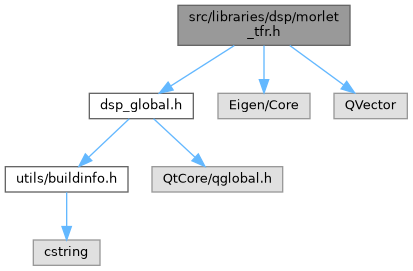

Complex Morlet wavelet time-frequency representation (TFR). More...


Go to the source code of this file.
Classes | |
| struct | UTILSLIB::MorletTfrResult |
| Result of a Morlet TFR computation for one channel. More... | |
| class | UTILSLIB::MorletTfr |
| Complex Morlet wavelet time-frequency representation. More... | |
Namespaces | |
| namespace | UTILSLIB |
| Shared utilities (I/O helpers, spectral analysis, layout management, warp algorithms). | |
Complex Morlet wavelet time-frequency representation (TFR).
SPDX-License-Identifier: BSD-3-Clause Copyright (c) 2026 MNE-CPP Authors
The complex Morlet wavelet ψ(t) = π^{-1/4} · e^{i2πf₀t} · e^{-t²/2σ²} is a Gaussian-modulated complex exponential and is by far the most popular wavelet for electrophysiological time-frequency analysis. At each analysis frequency f the wavelet is dilated so the number of cycles inside the Gaussian envelope (parameter n_cycles, typically 5–7) stays approximately constant; this gives a logarithmically scaled resolution Δt ∝ 1/f, Δf ∝ f matching the wavelet uncertainty principle.
The TFR is evaluated as a convolution of the signal with each wavelet — implemented in the frequency domain via FFT × FFT multiplication — yielding a complex time-frequency tensor whose squared magnitude is the instantaneous power and whose argument is the instantaneous phase. Trial-wise averaging of the complex tensor gives the inter-trial phase coherence (ITPC / phase-locking factor); averaging the power gives the event-related spectral perturbation (ERSP).
Definition in file morlet_tfr.h.